Support our Foundation of Myology project

An innovative technique for assessing the impact of antisense oligonucleotides on the central nervous system
Partager sur

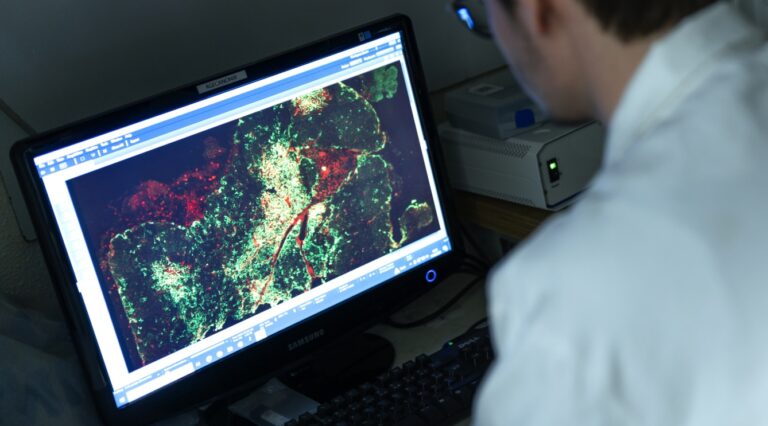
French and Dutch researchers sought to identify the effects of antisense oligonucleotides (ASOs) on the central nervous system (CNS) in Duchenne muscular dystrophy (DMD):
- a transcriptomic approach was used to spatially characterise the different dystrophin isoforms and their cellular localisation within the CNS,
- one of the mouse models of DMD, the mdx52 mouse, was analysed before and after ASO injection, which enabled exonPartie codante de l’ADN au sein d’un gène. 51 to be skipped and resulted in the re-expression of the full-length Dp427 isoform in the deep layers of the cortex and Ammon’s horn,
- the re-expression of other dystrophin isoforms is localised in other CNS structures.
This innovative approach also enables the tracing of markers of immune activation.