Support our Foundation of Myology project

New TMP3 variant: the phenotypic range of TMP3-related congenital myopathy expands
Partager sur
Mutations in the tropomyosin 3 (TPM3) gene are associated with autosomal dominantEn génétique, c’est la caractéristique d’un individu qui n’a besoin que d’un seul exemplaire d’un certain gène (allèle) pour s’exprimer. Cet exemplaire unique peut venir du père ou de la mère. and recessive nemaline 1 (NEM1) myopathy, congenital myopathy with disproportionate muscle fibre types and cap myopathy.
This French-Chilean study reports the case of a 47-year-old man with polycythemia, restricted vital capacity and mild apnea/hypopnea syndrome, requiring non-invasive ventilation.
Various additional examinations were carried out:
- physical assessment: this revealed bilateral ptosis and facial paresis, with an arched high palate and retrognathia; global hypotonia and diffuse axial weakness, including weakness of the neck and upper and lower limb girdles and weakness of foot dorsiflexion.
- muscle imaging: whole body MRI showed diffuse fat replacement with a non-specific pattern.
- molecular analysis: a panel of 122 neuromuscular disorder genes NGS revealed heterozygous SUV c.709G>A (p.Glu237Lys) on exonPartie codante de l’ADN au sein d’un gène. 8 of TMP3.
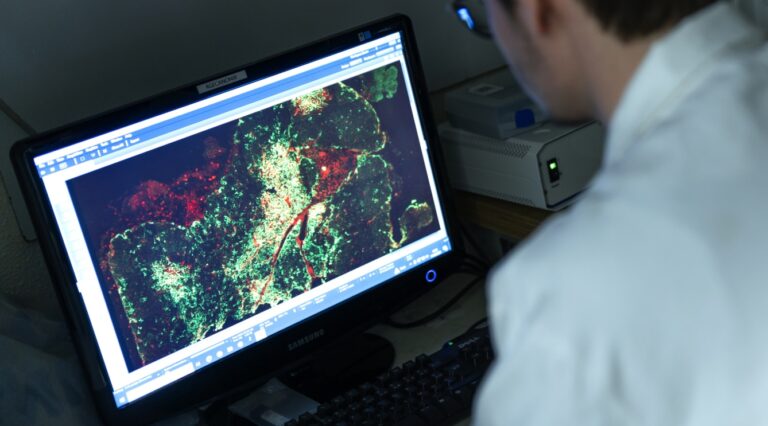
- histological analysis: a biopsy of the deltoid muscle showed a new histological pattern combining a disproportion of fibre types and caps.
These results support the pathogenicity of the new TMP3 variant and extend the phenotypic range of TMP3-related congenital myopathy.