Support our Foundation of Myology project

Gene therapy and DMD: a possible link with cardiac inflammation?
Partager sur
Following the serious side effects observed during trials of micro–dystrophin gene therapy using an AAV« adeno-associated virus » , ou virus adéno-associé est un petit virus à ADN simple brin. Il fait partie de la famille des Parvoviridae et appartient au genre des Dependovirus. La particule virale est constituée d’un brin d’ADN de polarité positive ou négative protégé par une capside. La taille moyenne d’une particule d’AAV et de 18 à 22 nm. Les AAV sont les seuls parvovirus non autonomes. Lorsqu’on emploie « rAAV » , il s’agit du virus AAV recombinant, c’est-à-dire qu’il a été modifié pour devenir un vecteur (et n’est donc plus virulent). viral vector in Duchenne muscular dystrophy (DMD), researchers at the Institute of Myology undertook to investigate the mechanismsinvolved in greater depth:
- a transgenic mouse with a double knockout for dystrophin and utrophin was used as an experimental model,
- treated with micro-dystrophin using an AAV delivered systemically, this mouse showed a significant prolongation of survival and improved cardiac function, at least during the first twelve months post-injection,
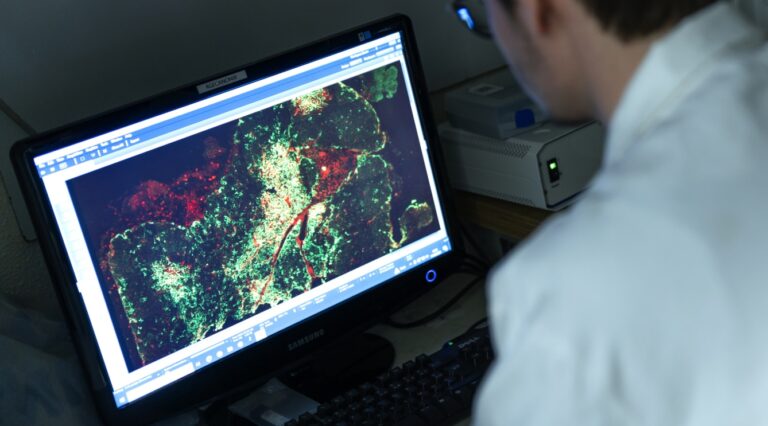
- however, additional histological analyses revealed thickening of the cardiac septum and, above all, a significant degree of inflammationRéaction non spécifique suscitée par un agent pathogène. with the presence of related biomarkers.
These findings are highly relevant in the context of the few cases of medium- to long-term myocarditis observed in some DMD patients who participated in clinical gene therapy protocols.