Support our Foundation of Myology project

Using gene therapy to treat CMT 1A through RNA interference
Partager sur
Charcot-Marie-Tooth disease type 1A (CMT1A) is an inherited sensory-motor neuropathy linked to the duplication of the PMP22 gene. Excessive production of PMP22 by Schwann cells disrupts the myelin sheath and interferes with peripheral nerve function.
RNAmacromolécule constituée d’une seule chaîne de nucléotides (simple brin) résultant de la transcription (copie) de l’ADN. interference is one of the therapeutic avenues being developed in CMT 1A to decrease the expression of PMP22 in Schwann cells. Two French teams are developing different approaches: one combines an interfering RNA with squalene nanoparticles, the other provides the interfering RNA through gene therapy.
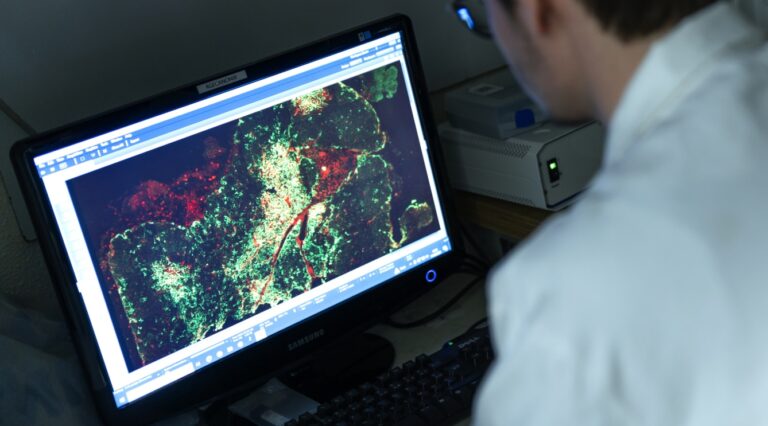
Researchers from the University of Montpellier in collaboration with I-Stem integrated a shRNA into an AAV-type gene therapy vector. Their results, published in April 2021 show that:
- after injection of the gene therapy product into the sciatic nerve of different animal models, numerous Schwann cells express the transgene;
- a single injection to rats with CMT 1A improves their clinical (muscle strength, agility, endurance), electrophysiological (nerve conduction speed) and histological (myelin sheath abnormalities) parameters.