Neuromuscular diseases (NMDs) cause progressive muscle weakness that significantly impairs patients’ functional abilities and quality of life.
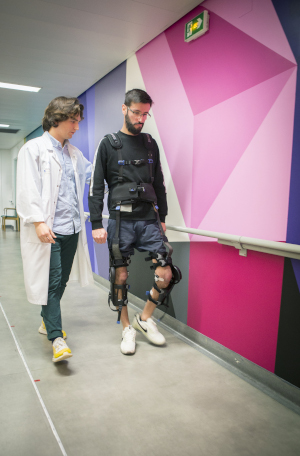
Romain Feigean, researchers in Neuromuscular Physiology and Evaluation Laboratory has published two articles assessing two motorised, wearable leg exoskeletons that show promise in improving the mobility and independence of people with NMD by supporting the hips and/or knees.
The aim was to study the safety, usability, effectiveness and biomechanical effects of the devices, which provide assistance during functional tasks, in a series of tests: a 2-minute walk test, a 10-metre walk test and a 30-second test to stand up from a seated position and static position. Test performance, perception of effort, breathlessness, pain and stability, spatio-temporal walking parameters, joint kinematics, muscle activation and muscle strength were recorded.
The results obtained with both devices show that:
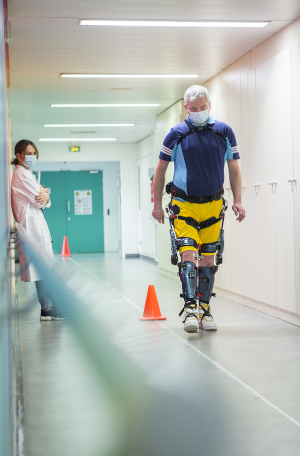 their use is safe under supervised conditions,
- the strength of the knee extensors, which is lower in NMDs, is not compensated for by the assistance provided by the exoskeleton,
- walking performance was significantly reduced, with a particular decrease in walking speed, stride length and cadence,
- the range of motion of hip flexion-extension was reduced,
- depending on the moment in the walking cycle, the level of muscle involvement was either increased or decreased.
These results indicate that, although the use of the devices did not improve walking performance, transfer performance or joint kinematics, they did reduce the muscular load in several muscle groups at key moments during walking.
Exoskeletons are generating considerable enthusiasm among patients with NMD. Although these initial studies fall short of expectations and home use is still a long way off, they nevertheless provide essential data for their further development. The authors therefore consider that the proposed approach remains promising. However, it requires a review of the design of the equipment and specific exoskeleton assistance. Ultimately, there will be a stage of individualisation of assistance according to the severity and distribution of muscle weakness.