 Maxime Jacoupy, Director of Data at the Institute of Myology, oversees the MyoData platform. With a PhD in neuroscience and a master’s degree in artificial intelligence, he embodies dual expertise at the interface of biomedical sciences and digital technologies.
His mission: to structure, ensure the reliability of, and make usable the data produced at all levels within the Institute.
Your background combines biology and data science. How is this dual training essential?
M.J. I am a researcher with additional training in data science/artificial intelligence. The platform’s objective is to design tools that are useful, reliable, and understandable to researchers. This requires mastery of several languages: those of biology, algorithms, and mathematics. The analysis methodology can be learned, but a solid scientific foundation remains essential.
How is MyoData’s work structured at the Institute level
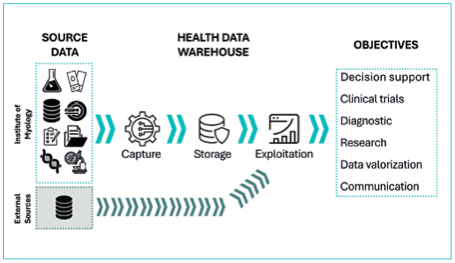 M.J. The team’s activity is based on two components. The first is analytical: researchers, doctors, and engineers are supported in the processing of their data, whether it be statistics, bioinformatics, or algorithm development. The second is structural: a global database, the MyoData Data Warehouse (EDS), is currently being developed to centralize the Institute’s data from clinical research, laboratories, and healthcare. It constitutes a cross- functional, secure foundation that complies with Health Data Hosting (HDS) certification requirements, which will enable new research to be carried out on this data
You are also involved in GenoTher, a biocluster dedicated to gene therapies. What is your role?
M.J. Through the MyoData EDS, we will be involved in the pre- and post-trial data analysis phase. The aim is to develop tools to evaluate the effectiveness of treatments, anticipate patient response, and limit the use of “control arms”. This work is based on approaches combining artificial intelligence and statistical modeling.
What future do you see for these practices?
M.J. Data analysis is already very advanced in oncology. In rare diseases, there is still some way to go, but that is precisely what makes the work so exciting. Once the data is well structured and accessible, these approaches can profoundly transform the way we generate knowledge and support patients.