Support our Foundation of Myology project

1699 news items

Research
Identification of a new mechanism underlying muscle pathology in DM1
On 19/10/2026
Researchers from the Repeat Expansions & Myotonic Dystrophy (REDs) team in the Center of Research in Myology at the Institute, whose work focuses on type…

Research
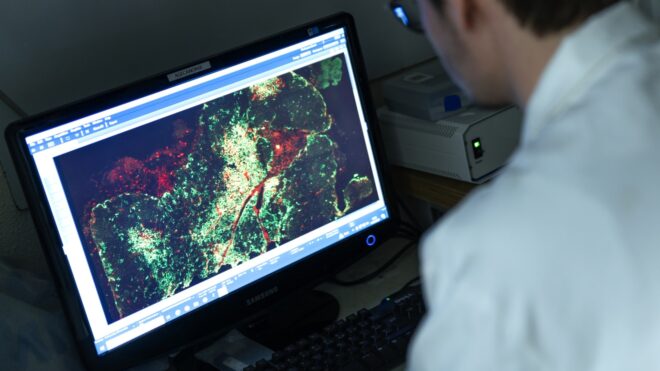
ALS: the thymus is both a target and a factor in the maintenance of the pathological process
On 16/10/2026
Julia Pereira Lemos, a researcher in the Biotherapy for motor neuron diseases (ALS & SMA) team in the Center for Research in Myology at the…
Research
CAR-T cells have led to a remission lasting at least 19 months in three patients with myasthenia gravis
On 14/10/2026
The anti-CD19 CAR-T cells KYV-101 are being evaluated in a Phase II/III trial involving 66 patients with refractory generalised autoimmune myasthenia gravis. Initial results for…

Events
A look back at the 2026 edition of the Fête de la Science at the Institute
On 13/10/2026
To mark the Fête de la Science, the Institute opened its doors for two days, on Wednesday 7 and Friday 9 October, to showcase its…

Teaching
Registration is now open for the AcadeMYO Winter School – 14-16 Dec. 2026 – online
On 12/10/2026
Join us for this unique opportunity to perfect your skills in myology, an increasingly exciting discipline dedicated to neuromuscular science!All professionals manifesting some interest in…

Clinical activity
SMA: a new treatment targeting muscle has just been approved for marketing in the US
On 12/10/2026
Isembyld (apitegromab) has been granted US marketing authorisation for the treatment of SMA On 11 September 2026, the US Food and Drug Administration (FDA) granted…

Events
The Institut de Myologie’s open-pace race, MyoRun, is celebrating its 20th edition!
On 09/10/2026
This year, the MyoRun open-pace race is celebrating its 20th edition and is offering two sporting and charitable events in aid of the 2026 Telethon!…

Research
The diagnostic and pathophysiological challenges of toxic vacuolar myopathies
On 09/10/2026
Clinician and researchers from the Institute of Myology, in collaboration with international researchers, have investigated myopathies induced by chloroquine (and its derivatives, referred to by…

Clinical activity
Muscle biopsy: a diagnostic technique that remains useful despite advances in genetics
On 08/10/2026
Italian researchers have examined the diagnostic value of muscle biopsy at a time when high-throughput sequencing (NGS) and immunoassays are increasingly relegating it to a…

Clinical activity
Pompe disease: stabilisation of motor function two years after switching to avalglucosidase alfa
On 08/10/2026
A French study analysed real-world data from 47 adults with late-onset Pompe disease who switched to avalglucosidase alfa (Nexviadyme) after treatment failure with alglucosidase alfa…

Research
A potential therapeutic benefit for DMD with the growth factor GDF5
On 08/10/2026
Researchers from the Center of Research in Myology* at the Institute have demonstrated the benefits of treatment with growth and differentiation factor 5 (GDF5) in…

Clinical activity
Digestive problems: not to be underestimated in Steinert disease
On 07/10/2026
A study assessed the frequency of gastrointestinal symptoms and their burden in 95 patients with the adult-onset form of Steinert disease. The authors recommend incorporating…

Clinical activity
MFM is now available as an app: pros and cons
On 07/10/2026
The teams in Lyon and Saint-Étienne, who designed and developed the Motor Function Measure (MFM), have announced that it is now available on a mobile…

Research
Triple Burden: sexual health in the spotlight at WMS 2026 – Audrey El Kaïm winner of the WMS Allied Health Prize
On 06/10/2026
Presented in Hiroshima, the Triple Burden project received the WMS Allied Health Prize. This award recognises collaborative work examining the place of sexuality in research…

Research
Eline Lemerle awarded the President’s Prize for Best Basic Science at the WMS 2026
On 06/10/2026
Eline Lemerle, a postdoctoral research fellow in the Muscle cell organisation and therapy for dominant centronuclear myopathy team headed by Marc Bitoun et Stéphane Vassilopoulos,…

Clinical activity
Inflammatory myopathies: a new technology helping with diagnosis
On 06/10/2026
Plasma proteomics studies to assess the clinical manifestations and tissue damage associated with certain inflammatory myopathies An international consortium of researchers, including a French team,…

Clinical activity
Intermittent positive pressure ventilation does indeed appear to have a positive effect on chest growth in children with type I SMA
On 06/10/2026
A French retrospective study assessed the effect of intermittent positive pressure ventilation (IPPV) using the Alpha 300® in seven children with type I spinal muscular…
Research
Inflammatory myopathies: certain autoimmune conditions carry a significant risk of pulmonary complications
On 05/10/2026
Autoimmune conditions that test positive for anti-Ku antibodies carry a significant risk of pulmonary complications Clinicians from ten centres within the Assistance-Publique Hôpitaux de Paris (APHP) compiled and compared the clinical and laboratory data of 154 adults…
Clinical activity
What CPK levels are genuinely pathological?
On 05/10/2026
British and Canadian researchers have sought to establish non-pathogenicity reference ranges for creatine phosphokinase (CPK) levels measured in routine clinical practice: According to the authors,…

Clinical activity
Awards for two young researchers from the Institute at the WMS 2026 conference
On 03/10/2026
The 2026 World Muscle Society Congress, which took place from 29 September to 3 October 2026 in Hiroshima, Japan, brought together the international neuromuscular community…